

Custom Printing for Event Organizers: The Complete Guide
Last Updated: October 28, 2026
Quick Summary
Custom printing for event organizers covers the physical touchpoints attendees hold, wear, or walk past: tickets, badges, programs, banners, signage, and apparel. Plan every item together so they share a color palette, typeface, and deadline, and set quantities with a 10-15% buffer for damage and last-minute additions.
- Printed materials divide into identity, navigation, and take-home groups by function.
- Work backward from venue load-in, not the event date, when scheduling production.
- Build in a buffer week for anything custom-manufactured or specialty-finished.
- Order apparel and promotional items to a planned give-away number, not headcount.
- Add a contingency line of roughly 5-10% of the total for reprints and additions.
Table of Contents
- What Custom Printing Covers for an Event
- Your Event Printing Checklist From Planning to Pickup
- Custom Event Tickets, Badges, and Programs
- Signage, Banners, and Displays That Guide a Crowd
- Event Printing Turnaround Time and Rush Options
- Custom Print Design Services and File Preparation
- Quantity Planning, Budgeting, and Cost Trade-Offs
- Ordering Your Event Print Package From HM Print & Design LLC
- Frequently Asked Questions
What Custom Printing Covers for an Event
Custom printing for event organizers can cover physical touchpoints such as tickets, badges, banners, programs, and apparel. HM Print & Design LLC offers commercial-grade printing services and custom banners, apparel, and promotional items for events.
The scope is wider than the word "printing" suggests. An event's printed layer includes:
- Entry materials: tickets, badges, lanyards, and check-in signage
- Wayfinding: directional signs, floor decals, and room markers
- Stage and sponsor graphics: backdrops, step-and-repeats, and banners
- Attendee materials: programs, flyers, brochures, and menus
- Brand presence: apparel, promotional items, and business cards
Most guides treat each item as a separate purchase. Every piece can share a color palette, a typeface, and a deadline. Plan them together or separately.
Printed Materials That Carry an Event
Printed materials are what attendees physically hold, wear, or walk past. They divide into three groups by function.
Identity materials tell people where they are and what they're attending: badges, tickets, programs, and welcome signage. These get the most handling and deserve the best stock you can justify.
Navigation materials move people: directional signs, banners, room markers, and floor graphics. Legibility at distance beats decorative detail every time.
Take-home materials extend the event past its final hour: brochures, business cards, invitations, and promotional items. These are the pieces attendees photograph and keep.
Your Event Printing Checklist From Planning to Pickup
This checklist can help organize planning from the first meeting through delivery.
-
Confirm date, venue, and attendee count (drives every quantity)
-
Lock the brand palette and typeface before any file is built
-
List every printed item by location and function
-
Set quantities with a 10-15% buffer for damage and last-minute additions
-
Pack a contingency kit: spare badges, tape, and a few extra programs
The buffer line is one planning consideration. A short run of materials can be a problem at check-in.
Choosing Products by Event Type, Venue, and Audience
Conferences, weddings, trade shows, and fundraisers can call for different printed materials. A wedding might use invitations, menus, programs, and keepsakes; a trade show might use banners, brochures, and promotional items.
Venue matters too. Consider the venue's requirements when planning signage and displays.
Audience sets the tone: corporate expects clean, restrained design, while a community fundraiser can carry more personality. Settle these three inputs early and product selection becomes straightforward.
Custom Event Tickets, Badges, and Programs
Custom event tickets can grant entry, carry information, and act as a keepsake.
Signage, Banners, and Displays That Guide a Crowd
Event signage can help attendees find locations such as the restroom, main hall, and coffee area.
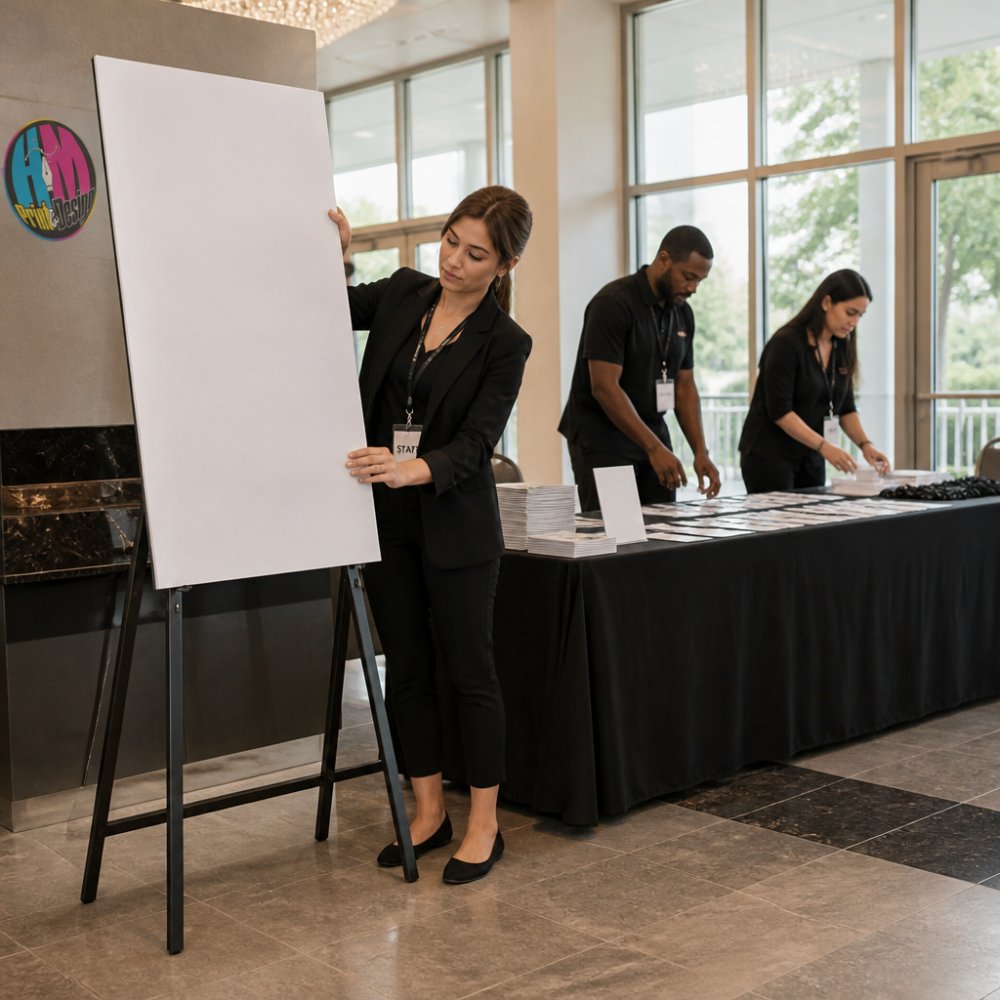
Banners and displays fall into a few practical categories:
- Welcome and sponsor banners: large format, viewed from a distance
- Directional signage: arrows, room names, and floor markers
- Freestanding displays: pull-up banners and easels for venues that restrict wall mounting
- Hanging displays: suspended pieces for high-ceiling spaces
Event Printing Turnaround Time and Rush Options
Plan backward from the event date when organizing event printing.
Production windows by item type
Treat those as planning ranges, not promises. Confirm the actual window for your items and quantities in writing before you set a load-in date.
A backward-planning schedule that works
Work backward from the date you need the materials, then consider each step:
- Venue load-in date, the hard deadline.
Rush options and their real trade-offs
Two rules keep timelines safe. First, work backward from venue load-in, not from the event date. Second, build in a buffer week for anything custom-manufactured or specialty-finished. For a closer look at how production schedules actually run, read our breakdown of how long custom sign production takes.
Contingency planning for delivery and installation
A ten-minute check when boxes land beats a scramble at load-in, if something is short or damaged, you want to know while there's still time to reprint a small run.
Custom Print Design Services and File Preparation
Typography deserves its own decision. A sign font that reads beautifully on a screen can turn illegible at banner scale, and our guide to choosing sign fonts that get noticed walks through matching type to viewing distance. If your artwork exists only as a JPG or a screenshot, our file conversion service for SVG, DXF, and EPS turns it into something production-ready.
Proofs, Proof Approval, and Print Quality Checks
Print quality checks happen twice: a press check or sample review during production, and a physical inspection on delivery. Open the boxes, count the run, and spot-check a few pieces before event day.
Quantity Planning, Budgeting, and Cost Trade-Offs
This section gives you a framework for estimating quantities item by item and considering how to avoid ordering print nobody touches.
Estimating quantities item by item
Start with the confirmed attendee count, then adjust per item based on how it's used:
- Apparel and promotional items: order to a planned give-away number, not to headcount.
Write the quantity and the reason next to every line item.
Where the money does the most work
When comparing quotes, compare like with like. A lower unit price on thinner stock or a lighter finish isn't a saving if the piece fails in use. Ask what changes when you move up a stock weight or add a finish, and decide whether the difference is visible to the attendee. If it isn't, don't pay for it.
A working budget formula
Fill it in before you commit, not after. Add a contingency line of roughly 5-10% of the total for reprints and last-minute additions. If the total comes in high, cut the item count rather than the quality of the pieces people actually hold.
Avoiding waste without running short
Before you commit, list every item, its quantity, unit cost, and the reason for that quantity.
Ordering Your Event Print Package From HM Print & Design LLC
Ordering your print package works best as one conversation rather than five separate orders. Tell us the event date, the venue, the attendee count, and the items you have in mind. We'll come back with a product list, a production schedule, and a quote before anything goes to press.
Browse the special events collection to see the product range and place your order.
Frequently Asked Questions
What printed materials do event organizers need?
Event organizers can consider which printed materials suit their event and audience. HM Print & Design LLC offers commercial-grade printing services and custom banners, apparel, and promotional items for events.
How far in advance should I order custom event tickets and other printing?
Work backward from your event date when planning. Check the product listing for details about the item you are considering.
What information should be included on custom event tickets?
Put the event name, date, start time, and full venue address on the front. Include ticket tier or access level, a unique ticket number, and any entry instructions such as doors-open time or dress code. On the back, add sponsor logos, a QR code or website for details, and your contact information. Keep the design readable at arm's length, since staff scan tickets quickly at the door. If you plan will-call or re-entry, state the policy in print so guests do not have to ask.
How many event programs or flyers should I print?
Print programs for roughly 70 to 80 percent of your expected attendance, since couples and groups often share one. Flyers work better as a promotional item before the event, so base that quantity on your outreach list rather than headcount. Always order a small buffer, usually 5 to 10 percent extra, for staff, sponsors, and replacements. Over-ordering wastes budget on paper and storage; under-ordering leaves late arrivals without materials. Confirm your final count before proof approval so quantities cannot change after production starts.
What file format and resolution do printers need for event artwork?
Supply print-ready PDFs with fonts outlined and images embedded at 300 dpi at final size. Include a bleed margin, usually 0.125 inches, and keep critical text inside the safe area. For large-format banners, artwork can be scaled down proportionally as long as resolution stays high. Name files clearly with the product and dimensions. If your designer works in another program, export to PDF rather than sending native files. Ask for a proof before production so you can catch color shifts, typos, and trim issues early.
How can I keep event signage and printed materials visually consistent?
Build one style sheet before design starts: logo files, two or three brand colors with print codes, approved fonts, and photo treatment rules. Apply it to every item, from tickets to banners, so the event reads as one experience. Consistency matters most at the entrance, where guests see several pieces at once. Ask your printer to run all items in the same production batch where possible, which reduces color variation between pieces. A single custom print design services contact who owns the whole package prevents drift between vendors.
What should I include in a quote request for custom event printing?
Check the product listing for details about the item you are considering.
Your event has a date, a venue, and an audience waiting. The printed layer is what makes all three feel intentional rather than improvised. HM Print & Design LLC brings commercial-grade printing together with hand-crafted signage, CNC 3D carved pieces, plasma metal cutting, and resin arts, so your tickets, banners, and displays share one standard of craftsmanship. Get started with HM Print & Design LLC and walk into your venue with every printed piece already in hand.
