

How Does Plasma Metal Cutting Work for Home Decor?
Last Updated: November 1, 2026
Quick Summary
Plasma metal cutting uses an electrically charged gas arc to slice through steel and other conductive metals, leaving clean outlines that suit wall art, custom signs, and decorative pieces. The plasma arc melts the metal while the gas blows the molten steel away from the cut line, producing a clean edge instead of a rough tear.
- Clear anything flammable within a wide radius, since sparks travel farther than people expect.
- Clamp the steel flat and check the ground connection before starting any cut.
- For covered porch or patio pieces, 14 gauge steel with a powder coat finish is a common choice.
- Keep decorative features comfortably wider than the kerf for the thickness you are cutting.
- Custom text is limited to 10 characters on the monogram signs, so plan lettering before ordering.
Table of Contents
- What Is Plasma Metal Cutting and How Does It Work?
- Plasma Cutter Art for Beginners: A Safety-First Workflow
- Choosing Metal Sheets and Thickness for Home Decor
- Where to Find Plasma Cutter Patterns and Cut Files
- CNC Plasma Cutting Projects for Repeatable Results
- Metal Art Finishing Techniques for Indoor and Outdoor Decor
- Ordering Custom Plasma-Cut Decor from HM Print & Design LLC
- Frequently Asked Questions
What Is Plasma Metal Cutting and How Does It Work?
Plasma metal cutting is a process that uses an electrically charged gas arc to slice through steel and other conductive metals, leaving clean outlines that suit wall art, custom signs, and decorative pieces. This guide covers how the process works and how to use it for home decor. At its core, plasma cutting is simple: focused heat meets controlled speed.
How the Plasma Arc Cuts Through Steel
Here's the short version. A plasma cutter sends gas through a nozzle and charges it with electricity. That creates a plasma arc hot enough to melt metal. The gas blows the molten steel away from the cut line, so you get a clean edge instead of a rough tear.
The nozzle stays cool because the gas swirls around the arc. That's the trick that makes the tool practical for thin sheet metal. Thicker steel needs slower travel and more power. Thin steel cuts fast but warps if you rush it.
If you're ready to buy rather than build, our Custom Metal Art guide covers the options available for finished pieces.
Plasma Cutter Art for Beginners: A Safety-First Workflow
Start with safety, not design. Most beginner mistakes happen before the torch ever touches metal. The Occupational Safety and Health Administration treats welding and cutting arcs as a hazard source, and plasma cutting deserves the same respect.
Here's the workflow we'd follow:
- Clear the area. Remove anything flammable within a wide radius. Sparks travel farther than people expect.
- Set up ventilation. Cutting metal throws smoke and fine dust. Work near an open door or a fume extractor.
- Suit up. Safety glasses under a face shield, leather gloves, and a long-sleeve jacket. No synthetic fabrics.
- Clamp the steel. A loose sheet shifts mid-cut and ruins the line. Clamp it flat and check the ground connection.
- Keep a fire extinguisher within reach. Not in the next room. Within reach.
- Practice on scrap first. Run a few straight lines before you attempt a real design.
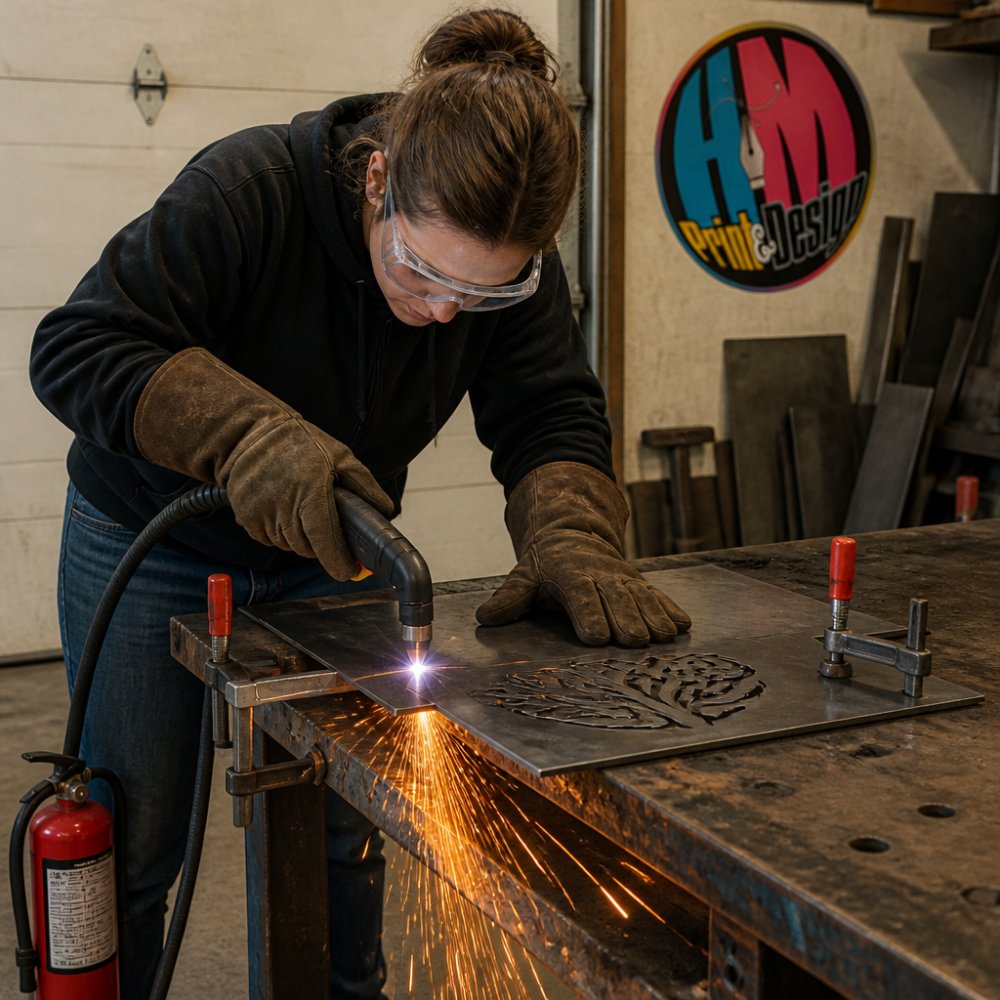
Watch out: cutting over a concrete floor without protection can pop chips from trapped moisture. Use a metal cutting table or a fire-rated surface instead.
Choosing Metal Sheets and Thickness for Home Decor
Thickness decides how a piece looks, how it cuts, and how long it lasts. Thin steel cuts easily but feels flimsy on a wall. Thicker steel holds its shape and reads as a serious decorative piece. The practical question is not just "how thick" but "thick enough for the job, thin enough for my equipment."
Here's a working guide for common decor projects:
| Thickness | Typical Use | Cut Behavior | Watch Out For |
|---|---|---|---|
| 18 gauge (about 0.048 in) | Small indoor accents, layered scenes, ornaments | Cuts fast at low amperage; edges are easy to deburr | Dents easily; warps if you rush the travel speed |
| 16 gauge (about 0.060 in) | Wall art, monograms, indoor signs | Good balance of stiffness and cut speed | Still thin enough to oil-can on large unsupported panels |
| 14 gauge (about 0.075 in) | Custom signs, garden art, porch decor | Needs a stronger cutter; holds shape well | Slower cuts; more dross to clean if speed is off |
| 3/16 inch (about 0.188 in) | Larger outdoor pieces, sculpture, brackets | Noticeably slower; heat input rises | More cleanup and a beefier table or support |
| 1/4 inch and up | Heavy functional decor, structural accents | Demands serious equipment and consumables | Not a beginner thickness for decorative detail work |
Match the metal to the setting. Mild steel is a common choice for painted and powder-coated decor. The metal you choose for a given project depends on the look and environment you want.
Thickness changes the cut, not just the part. As steel gets thicker, the plasma arc needs more amperage and slower travel speed to cut cleanly through the full thickness.
Plan for support and span. A large panel in 18 gauge will sag or flex when hung unless it is backed, framed, or mounted close to the wall. A smaller piece in 14 gauge can hang from a single hole without support. If the design has long unsupported spans, step up one gauge rather than adding hidden bracing.
Indoor versus outdoor. For covered porch or patio pieces, 14 gauge steel with a powder coat finish is a common choice.
Buy a test offcut first. A common mistake is buying a full sheet before testing a design. Start with a small offcut in the thickness you plan to use. You'll learn more from one test cut, how the arc behaves, how much dross forms, how the edge cleans up, than from any spec sheet.
A common mistake is buying a full sheet before testing a design. Start with a small offcut in the thickness you plan to use. You'll learn more from one test cut than from any spec sheet.
Where to Find Plasma Cutter Patterns and Cut Files
Plasma cutter patterns come from several sources. Whatever the source, check that the file is ready to cut before using it.
- Marketplace files vary in quality. Check that the listing states the file format.
- Free file libraries work for simple shapes, though many need cleanup before cutting. Expect to close open paths and remove stray nodes.
- Your own designs take more time but give you something nobody else has, and you control every cut parameter.
Start with a clean vector. Plasma tables follow a toolpath, so the file needs closed paths with no stray nodes or overlapping lines. Open paths confuse the machine and cause missed cuts or unexpected pierces.
Understand kerf and minimum feature size. The plasma arc removes a small width of material, the kerf, so every cut line is slightly wider than the drawn line. Fine details, sharp inside corners, and thin bridges between cutouts can disappear or weaken if they are narrower than the kerf plus a safety margin.
Place pierce points away from finished edges. The arc pierces the steel at the start of each cut, and that pierce leaves a small mark. Good files put pierce points on scrap or on an edge that will be cleaned up, not in the middle of a visible face.
Match cut settings to the job. Amperage, travel speed, and air pressure work together. Too fast leaves dross on the bottom edge; too slow overheats the edge and can warp thin sheet. Air pressure that is too low gives a ragged cut, and moisture in the air line shows up as porosity or a rough edge.
Scaling changes the cut. Scaling a file up or down changes how fine details survive the cut. A line that is thin at one size may disappear at another, and a feature that clears the kerf at 12 inches may not at 6 inches. Test the actual size before you commit.
If you're designing a monogram or a custom motif, our guide to designing metal monograms covers how to keep letterforms readable after cutting.
CNC Plasma Cutting Projects for Repeatable Results
CNC plasma cutting projects shine when you need the same design more than once. A CNC plasma table moves the torch along a programmed path, so every piece matches the last. That matters for seasonal decor lines, matching sets, and small batch sales.
Good projects to start with:
- Layered scenes where two or three cut panels stack for depth
- Silhouette wall art with clean outlines and simple shapes
- Geometric designs that repeat across a series
- Wildlife scenes cut as single panels or layered sets
- Household decor like hooks, brackets, and trivets
The setup is where quality is won or lost. Check your cut settings against the material, not against last week's job. Clean the consumables. Run a dry pass to confirm the path before you fire the torch.
Metal Art Finishing Techniques for Indoor and Outdoor Decor
Finishing is what turns a cut sheet into decor. The right finish protects the steel and sets the look. For pieces headed to patios and porches, see our guide to materials for outdoor signs.
- Powder coating bonds a durable color layer to the metal and resists rust, humidity, and fading.
The American Welding Society publishes reference material on metal finishing and fabrication standards if you want to go deeper.
Ordering Custom Plasma-Cut Decor from HM Print & Design LLC
Not everyone wants a torch in the garage. If you'd rather skip the equipment, the fumes, and the learning curve, ordering a finished piece is the faster path. HM Print & Design LLC offers finished decor pieces, so you can get the look without the workshop.
A few of our pieces show what's possible:
- The Wine Bottle Custom Monogram Metal Sign starts at $39.99 and is made from 14 gauge steel sourced in the USA.
- The Welcome to the Lake Metal Powder Coated Sign starts at $24.00 and is powder coated for weather resistance.
- The Golf Hole Custom Monogram Steel Sign is $39.00, laser cut from 14 gauge American steel with a powder coated finish.
Custom text is limited to 10 characters on the monogram signs, so plan your lettering before you order.


Ready to see the full range? Browse our decor collection to find a finished piece that fits your space.
Frequently Asked Questions
What home decor can you make with a plasma cutter?
Plasma cutters handle wall art, custom metal signs, garden stakes, house numbers, silhouette panels, and layered scenes. Flat sheet metal up to about 1/2 inch is the practical range for most home shops. Simple shapes and clean outlines work best for beginners, while detailed geometric designs and wildlife scenes suit CNC tables. You can finish pieces with paint or powder coating for indoor display or weather resistance.
How do you design a pattern for plasma-cut metal art?
Start with vector design software and draw closed shapes with no overlapping lines. Free plasma cutter patterns exist online, but verify dimensions before cutting a full sheet.
How do you prevent plasma-cut metal art from rusting?
Clean the piece, remove dross, and apply a powder coat or exterior-grade paint within a day of cutting. Powder coating bonds to the steel and resists rust, humidity, and fading, which is why it suits outdoor signs and garden art. For indoor pieces, a clear coat over raw metal preserves the rustic look.
Is CNC plasma cutting better than handheld cutting for detailed designs?
CNC plasma cutting wins for detailed designs because the table follows the cut file exactly, giving repeatable clean outlines and tight tolerances. Handheld torches work for simple shapes, repairs, and one-off cuts where a steady hand is enough. For layered scenes, geometric patterns, or custom signs with lettering, CNC is the practical choice. Expect a steeper setup cost and a learning curve with the software.
Plasma cutting rewards preparation more than talent. Clamp your steel, test your settings, and finish the piece properly, and the results hold up. If you'd rather leave the cutting to us, HM Print & Design LLC offers hand-crafted plasma metal cutting, CNC 3D carved signs, and resin arts, all made to order with powder coated finishes and hanging holes included. Get started with HM Print & Design LLC and add a personalized metal piece to your home.
