

7 Rustic Decor Ideas for Modern Spaces That Work
Last Updated: October 30, 2026
Quick Summary
Rustic decor works in modern spaces when you follow the 70/30 rule: roughly 70% of a room reads modern and 30% reads rustic. Keep to two wood tones, one stone surface, three textile textures, and one metal finish, and layer warm light at three heights.
- Treat rustic decor as seasoning, not the whole meal, and get the modern shell right before adding character pieces.
- Choose one focal point before shopping and filter every purchase against it.
- In small spaces, pick two rustic wood tones and repeat them to avoid clutter.
- Hang rustic wood wall decor at roughly 57 to 60 inches to the center of the piece.
- Use warm white bulbs at 2700K to 3000K, since cooler bulbs turn oak gray.
Table of Contents
- How to Mix Rustic Decor Into a Modern Space
- Modern Rustic Living Room Ideas That Anchor the Room
- Rustic Decor Ideas for Small Spaces and Apartments
- Rustic Wood Wall Decor: Where It Belongs and How to Hang It
- Materials, Colors, and Textures That Keep Rustic Looking Current
- Lighting and Upkeep: Making Rustic Decor Last
- Shop Rustic Decor by Room
- Frequently Asked Questions
How to Mix Rustic Decor Into a Modern Space
Rustic decor for modern spaces works when you treat it as a seasoning, not the whole meal.
At HM Print & Design LLC, we offer hand-crafted decor for this kind of room. The trick is proportion, not volume.
Modern rustic is an interior style that pairs clean-lined contemporary furniture with natural materials, warm earth tones, and hand-made textures.
Most guides get this wrong.
The 70/30 Rule for Balancing Rustic and Modern
The 70/30 rule is simple: roughly 70% of a room should read modern, and 30% should read rustic.
In practice, a modern sofa, modern window treatments, and a clean wall color carry the room.
A common mistake is buying rustic pieces first and trying to modernize around them. Do the reverse.
Apartment Therapy's guide to mixing design styles makes a similar point: contrast needs a neutral base to sit against.
Modern Rustic Living Room Ideas That Anchor the Room
Start with the focal point, not the shopping cart.
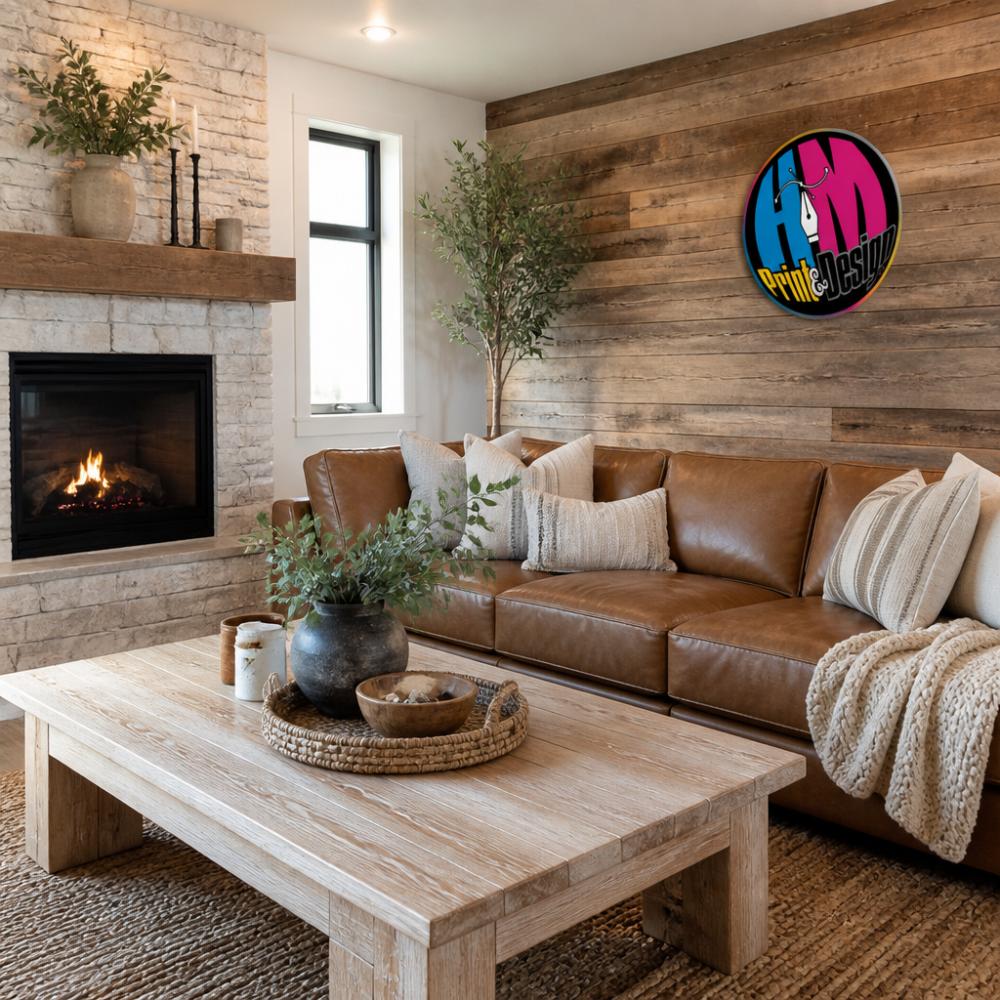
Once the anchor is set, everything else supports it. A leather sofa adds warmth without pattern. Natural linen pillows soften the leather. A pale wood coffee table keeps the palette light.
For high-ceiling rooms, a rustic wagon wheel chandelier can serve as the anchor. Its wood frame and seeded glass shades throw textured light.

Choosing a Focal Point Before You Shop
Ask one question before you buy anything: what does someone see when they walk in? If the answer is "a blank wall," that wall is your focal point. If it's "the TV," plan around the TV.
Write the answer down, then filter every purchase against it. A piece that doesn't support the focal point is one you'll move in six months.
Rustic Decor Ideas for Small Spaces and Apartments
Small spaces need rustic decor that works vertically and doesn't eat floor area. Wall-mounted pieces, tiered trays, and compact lanterns give you texture without the footprint.
Three ideas that work in apartments:
- Wall shelves over floor furniture. A wood and iron circle shelf holds small plants and candles in a 17.5-inch circle, adding storage without a table underneath.
- Tiered trays on a counter. A two-tiered tray stacks decor upward in a 13-inch footprint.
- Small lanterns on a console. A set of natural wood lanterns in two sizes gives you height variation without a big piece.
Watch out: in a small room, three rustic wood tones start to look cluttered. Pick two and repeat them.


Rustic Wood Wall Decor: Where It Belongs and How to Hang It
Rustic wood wall decor belongs where a wall feels empty but the floor is already busy: above a console, beside a doorway, over a bed, or on the chimney breast.
Hang it at eye level, roughly 57 to 60 inches to the center of the piece, the standard gallery height most designers use, which keeps a wood piece from floating too high.
For a wall that needs both storage and style, the wood and iron circle shelf handles both. It holds up to 10 lbs total.
Materials, Colors, and Textures That Keep Rustic Looking Current
The materials that keep rustic decor current are the quiet ones: pale wood, dark wood used sparingly, stone, linen, leather, and matte ceramic. For a deeper guide to the best materials for rustic farmhouse decor, see our full article. Skip the orange-toned pine and the heavy distressing. What most guides leave out is where to source each material, what it costs, and how it ages, so here is the practical layer.
The Material Palette
| Element | Choose | Avoid |
|---|---|---|
| Wood tones | Pale oak, walnut, ash gray | Orange pine, yellow maple |
| Walls | Warm white, greige, soft clay | Cool gray, stark white |
| Accents | Mossy green, terracotta, black iron | Bright primary colors |
| Textiles | Natural linen, cotton, wool | Shiny synthetics, heavy prints |
Color does the rest. A warm, subdued palette holds up over time because it doesn't fight the wood. Keep walls in the warm-white-to-greige range, let the wood supply the mid-tone, and repeat one accent color, mossy green, terracotta, or black iron, in at least three places so it reads as intentional.
How Much of Each Material
Proportion is what separates modern rustic from cabin. A workable ratio for a living room:
- Wood: one dominant tone across large pieces (flooring, table, shelving), plus one secondary tone in a small accent. Two tones total, not four.
- Stone: one stone surface, a hearth, a mantel, a tabletop, is enough. Two in a small room start to feel heavy.
- Textiles: at least three textures (a smooth leather, a nubby linen, a soft wool) in the same warm neutral family.
Layered textures separate a styled room from a flat one: a nubby linen pillow next to smooth leather, a matte ceramic vase on a glossy stone mantel. The contrast is the point, but it works only when the colors stay in one family.
Budget Tiers and Sourcing
You can build this look at three price levels. The material list stays the same; the sourcing changes.
Lower budget, lookalikes and secondhand.
- Engineered wood or wood-veneer tables in a pale oak finish instead of solid white oak.
- Reclaimed lumber from salvage yards and architectural salvage dealers, often priced below new hardwood and already weathered.
- Secondhand leather chairs and wool blankets from estate sales and resale marketplaces; leather and wool age well and hide wear.
Mid budget, solid where it counts.
- Solid wood on the pieces you touch daily (tabletop, shelf, bed frame) and veneer on the pieces you don't.
- Stone-look quartz or a stone remnant for a hearth or tabletop; fabricators often sell remnants at a discount.
- Linen and cotton blends rather than 100% linen, which wrinkles and stretches more.
Higher budget, full material honesty.
- Solid white oak, walnut, or ash with a hardwax oil finish rather than a plastic-feeling lacquer.
- Natural stone slab for a hearth or tabletop, sealed for the room it lives in.
- Full-grain leather and 100% linen; both cost more up front and outlast the alternatives.
Durability and Responsible Sourcing
Durability is a material question, not a brand question. Solid wood can be sanded and refinished; veneer cannot. Full-grain leather develops a patina; bonded leather peels. Natural stone stains if unsealed; quartz doesn't but reads more contemporary.
Lighting and Upkeep: Making Rustic Decor Last
Lighting shapes how a modern rustic room feels. The furniture and materials are right, but a single overhead fixture flattens every texture you paid for. Rustic decor depends on raking light, light that skims across wood grain, stone face, and linen weave, and that only happens when you layer three sources instead of one.
The Three-Layer Lighting Plan
Build the room in this order, and don't skip a layer:
- Ambient (the base). A ceiling fixture or recessed cans set to warm white. Target 2700K-3000K. Cooler bulbs (3500K and up) turn oak gray and make stone look cold and institutional.
- Task (the work light). A floor lamp beside the reading chair, a swing-arm sconce over a console, or under-cabinet strip lighting in a kitchen. Task light makes a room usable after dark, not just photogenic.
- Accent (the texture light). This is the layer that sells rustic. A plug-in wall sconce aimed across a reclaimed beam, a picture light over a wood sign, or a small uplight behind a stone hearth. Accent light creates shadow, and shadow gives rough-sawn wood and stacked stone their depth.
A practical rule: every room needs at least one light source at three different heights, ceiling, eye level (lamp or sconce), and low (table or floor). Rooms with only ceiling light read as flat no matter how good the decor is.
Fixture Scale and Style
Match the fixture to the architecture, not to the furniture. In a room with a standard 8-foot ceiling, a chandelier should hang so its lowest point sits about 30-36 inches above the table or 7 feet above the floor in a walkway.
For modern rustic specifically, choose fixtures with one rustic material and one clean material: wood frame with black steel arms, seeded glass with a matte brass canopy, wrought iron with a linen shade.
Integrating Smart Controls Without Losing Warmth
Smart lighting does not have to mean cool white and app-only control. A few moves keep the technology invisible:
- Use warm-white smart bulbs or dimmers rated 2700K-3000K, and set scenes to dim rather than change color temperature.
- Put ambient and accent layers on separate dimmers or smart switches so you can run accent-only in the evening, the look most people actually want.
- Choose smart switches over smart bulbs where fixtures use multiple bulbs; it keeps the fixture choice open and avoids one bulb failing out of sync.
Upkeep by Material
Rustic materials are durable, but each one fails differently. A short schedule beats a deep clean once a year.
| Material | Routine care | Avoid | Watch for |
|---|---|---|---|
| Solid and reclaimed wood | Dust weekly with a dry microfiber cloth; wipe spills promptly with a barely damp cloth and dry immediately | Spray polish and silicone furniture polish, which build up in open grain | Splitting near heat sources; white rings from wet glasses |
| Stone (hearth, mantel, tabletop) | Damp cloth with mild soap; dry fully | Acidic cleaners on limestone and marble | Staining on unsealed stone; efflorescence (white powder) on masonry |
| Leather | Vacuum with a soft brush; wipe with a barely damp cloth; condition sparingly | Harsh solvents and over-conditioning | Drying and cracking near heat vents and direct sun |
| Linen, cotton, wool | Vacuum upholstery monthly; rotate cushions; spot clean | Hot water and high-heat drying on wool | Pilling on linen blends; sun fading on one side of a sofa |
| Iron and metal | Dry cloth; touch up chips promptly | Abrasive pads on painted or powder-coated finishes | Rust bloom in humid rooms |
Two habits prevent most damage. First, keep wood and leather out of direct sun and away from heat vents and radiators, both dry out and crack faster than anything else in the room. Second, control indoor humidity; wood moves with moisture, and a room that swings from dry winter air to humid summer air will show gaps, cupping, and finish cracks.
Best for: rooms with real wood, stone, leather, or iron that get daily use. Skip if: you want zero-maintenance decor, in that case lean on ceramic, glass, and powder-coated metal, and accept that the room will read more modern than rustic.
Shop Rustic Decor by Room
The fastest way to get this right is to shop one room at a time, not one style at a time. Pick your focal point, choose two wood tones, then buy pieces that fit that plan.
Start with something versatile. A treenware dough bowl works on a kitchen table, a coffee table, a shelf, or an entryway console, making it an easy first piece while you decide on the rest of the room.
That's the whole approach: modern shell, rustic accent, warm light, and restraint. Most rooms fail because people add a fourth rustic piece when three would have done the job.
Frequently Asked Questions
How do you mix rustic and modern decor without it looking cluttered?
Pick one rustic anchor per room, such as a wood mantel or a stone fireplace surround, then keep everything around it sleek. A rough ratio of 70 percent modern to 30 percent rustic keeps the room calm. Repeat one material, like pale wood, two or three times so the rustic pieces read as intentional rather than collected at random.
What materials work best for modern rustic interiors?
Wood, stone, metal, glass, and linen do most of the work. Pair those with matte ceramics, seeded glass, and natural linens. Skip anything with heavy fake distressing, since that is what makes rustic decor look dated in a contemporary room.
Can rustic decor work in a small modern home or apartment?
Yes, if you scale the pieces down and go vertical. A 17.5-inch round wood and iron shelf or a two-tiered tray can add rustic accents in a small space. Keep the palette light, use one or two textured pieces per room, and hang wall decor higher to draw the eye up. Avoid oversized lanterns and deep furniture in tight rooms.
How do you keep rustic decor from looking dated?
Limit the number of distressed finishes, and update the surrounding pieces instead of the rustic ones. Swap dated accessories for matte ceramics, seeded glass, and simple greenery. Warm, subdued colors like earthy tones and mossy green age better than orange-heavy palettes. If a piece feels tired, restyle it with fresh linens or candles before replacing it.
Mixing rustic and modern takes more judgment than a shopping spree, and the pieces that make it work are usually the ones made with real care. HM Print & Design LLC builds exactly that: CNC 3D carved signs, plasma metal cutting, hand-crafted decor, and resin art, plus commercial-grade printing when you need it. Every piece is made to your spec, so it fits your room instead of the other way around. Get started with HM Print & Design LLC and give your space a focal point worth building around.
