

Rustic Farmhouse Chandelier Materials and Styles That Work
Last Updated: November 8, 2026
Quick Summary
A rustic farmhouse chandelier is a hanging light fixture built from natural, time-worn materials like wood, wrought iron, and glass, designed to bring country-style warmth to a room. The defining silhouettes are wagon wheel and barn-inspired frames, while lantern, cage, and mason jar forms suit kitchen islands and foyers. Wood brings warmth, iron brings structure, and glass shapes the quality of light.
- A wagon wheel needs vertical room for spokes and chains, so skip it for a standard eight-foot ceiling.
- Reclaimed wood is generally more durable than aged wood, which is softer and more likely to show a new dent.
- A large iron wagon wheel can weigh several times what a comparable wood frame does.
- Add the room's length and width in feet and treat the total as the fixture's diameter in inches.
- Place the bottom of the fixture about 30 to 36 inches above the tabletop.
Table of Contents
- Farmhouse Chandelier Styles: From Wagon Wheel to Lantern
- Rustic Chandelier Materials: Wood, Iron, and Glass Compared
- Finishes and Glass Options That Set the Tone
- Traditional Rustic Versus Modern Farmhouse Looks
- How to Choose a Dining Room Chandelier: Size, Height, and Bulbs
- Safety, Electrical Ratings, and Long-Term Care
- Shop HM Print & Design Chandeliers and Rustic Decor
- Frequently Asked Questions
Farmhouse Chandelier Styles: From Wagon Wheel to Lantern
A rustic farmhouse chandelier is a hanging light fixture built from natural, time-worn materials like wood, wrought iron, and glass, designed to bring country-style warmth to a room. At HM Print & Design LLC, shoppers get stuck on one question first: which silhouette belongs over the table? The answer comes down to the room's architecture and how much visual weight the ceiling can carry.
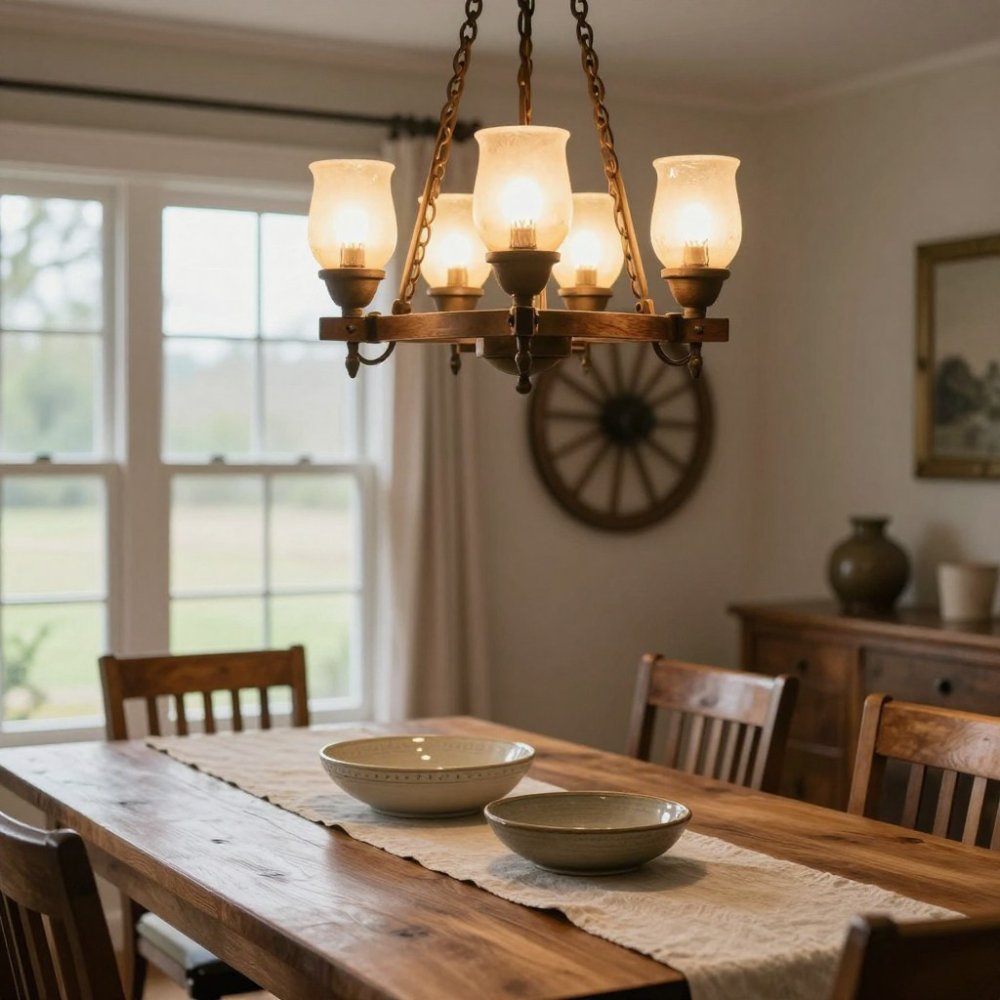
Wagon Wheel and Barn-Inspired Frames
The wagon wheel is the defining farmhouse shape: a circular wood or metal frame with spokes radiating from a center hub, often wrapped with exposed bulbs or glass shades.
If the wagon wheel silhouette is the look you want, our rustic wagon wheel chandelier with a wood frame and seeded glass comes in 6, 8, 12, and 18-light configurations, with diameters from about 26 to 59 inches.
Lantern, Cage, and Mason Jar Forms
Lantern-style fixtures trade the circle for a box: a metal or wood frame with glass panels, often with a peaked top. Cage chandeliers strip the glass away and leave the bulbs exposed inside an open metal grid. Mason jar glass takes the country aesthetic literally, using jar-shaped shades that soften the light. These three forms work best over kitchen islands and in foyers where a wagon wheel would feel too wide, and they handle lower ceilings better because they hang deeper than they spread.
Rustic Chandelier Materials: Wood, Iron, and Glass Compared
Material choice affects how a fixture looks and feels over time, how much it weighs, and which rooms it suits. Wood brings warmth and visible grain. Iron brings structure and a patina that develops with age. Glass shapes the quality of light.
| Material | Durability | Weight | Maintenance | How the Finish Ages | Best Rooms |
|---|---|---|---|---|---|
| Reclaimed wood | High; resists dents, but sensitive to moisture | Moderate | Dust dry; keep away from steam and leaks | Grain darkens slightly; knots and color variation remain | Dining rooms, heavy timber ceilings, covered porches with a damp rating |
| Aged or distressed wood | Moderate; softer than reclaimed | Moderate | Dust dry; avoid wet cloths | Distressing stays fixed; stain may lighten in direct sun | Bedrooms, breakfast nooks, casual dining |
| Wrought iron | Very high; resists impact and sag | Heavy | Wipe with soft cloth; touch up scratches | Patina deepens; rust can spread if scratches are ignored | High ceilings, industrial farmhouse, open floor plans |
| Aged iron or distressed metal | High; finish hides wear | Heavy | Wipe; avoid abrasive pads | Finish shifts gradually; fingerprints hide well | Kitchens, foyers, rooms with metal hardware |
| Seeded glass | Moderate; chips at edges if struck | Light | Glass cleaner and gentle cloth | Bubbles stay fixed; no fading | Warm ambient light over tables and islands |
| Amber glass | Moderate; same handling as seeded | Light | Glass cleaner and gentle cloth | Color stays stable; heat exposure can dull the surface | Traditional rustic rooms, wood-heavy palettes |
| Mason jar glass | Moderate; thicker than seeded | Light | Glass cleaner and gentle cloth | Clear glass shows dust sooner | Kitchens, casual dining, country-style nooks |
Reclaimed Wood, Aged Wood, and Heavy Timber
Reclaimed wood comes from old barns, fences, and buildings, so every piece carries a different grain pattern and color. Aged wood is new lumber treated to look weathered through distressing and staining. Heavy timber means thick, structural-grade beams rather than thin slats. Reclaimed pieces vary from unit to unit, so expect slight differences between two fixtures of the same model.
Wrought Iron, Aged Iron, and Distressed Metal
Wrought iron is handworked metal, shaped while hot, which gives it a slightly irregular surface that machine-cast metal lacks. Aged iron and distressed metal are finishes applied to mimic rust and wear, hiding fingerprints and small scratches far better than polished chrome. The trade-off is weight: a large iron wagon wheel can weigh several times what a comparable wood frame does, so the ceiling box and anchor must carry that load, not drywall alone.
Glass: Seeded, Amber, Clear, and Mason Jar
Glass changes the light rather than the structure. Seeded glass scatters light through its bubbles for a soft, textured glow and hides bulb glare better than clear glass. Amber glass warms the light toward a golden tone and suits traditional rustic rooms with brown and deep-red palettes. Clear glass shows the bulbs plainly and reads more modern than rustic. Mason jar glass is thicker and more casual, and it works best where the fixture is meant to feel collected rather than designed.
Matching Material to Room and Ceiling
The material decision should follow the room, not the other way around. A heavy iron fixture belongs on a ceiling that can carry it and in a room with enough volume to balance its visual weight.
For a deeper look at how these materials compare across farmhouse decor, our guide to the best materials for rustic farmhouse decor covers wood, metal, and glass in more detail.
Finishes and Glass Options That Set the Tone
Finish and glass do more to set the mood than the frame shape does. A distressed finish keeps a fixture casual; a matte black or aged iron finish pushes it toward industrial farmhouse.
If you are still deciding between glass types, browsing the glass fixture collection lets you see how seeded and amber shades actually look in a finished piece.
Traditional Rustic Versus Modern Farmhouse Looks
Traditional rustic leans into natural and time-worn: rough-hewn wood, visible knots, aged iron, amber glass, and a palette of browns and deep reds. Modern farmhouse keeps the rustic materials but cleans up the lines: simpler frames, matte black or white finishes, seeded glass instead of amber, and more white and gray in the surrounding room.
Blending the two is common and works well. If you are weighing that mix, our ideas for rustic decor in modern spaces show how to keep a time-worn fixture from fighting a contemporary room.
How to Choose a Dining Room Chandelier: Size, Height, and Bulbs
The right dining room chandelier is sized to the table, hung high enough to clear sightlines, and fitted with bulbs that suit the room's use.
Sizing rule: add the room's length and width in feet, and treat the total as the fixture's diameter in inches.
Hanging height: a common guideline is to place the bottom of the fixture about 30 to 36 inches above the tabletop, adding height for taller ceilings.
Worked Examples for Common Room Sizes
- 10-by-12-foot dining room, eight-foot ceiling: room rule points to a 22-inch fixture; a 60-inch table points to 30 to 40 inches. Choose a fixture near 22 to 26 inches and hang the bottom 30 to 36 inches above the tabletop.
- 12-by-14-foot dining room, nine-foot ceiling: room rule points to a 26-inch fixture; a 72-inch table points to 36 to 48 inches. Choose a fixture near 26 to 32 inches and hang the bottom 33 to 39 inches above the tabletop.
- 14-by-16-foot dining room, ten-foot ceiling: room rule points to a 30-inch fixture; an 84-inch table points to 42 to 56 inches. Choose a fixture near 30 to 36 inches and hang the bottom 36 to 42 inches above the tabletop.
Hanging Height, Chain Length, and Ceiling Type
Chain length is an easy detail to overlook. A fixture that ships with a short chain will not reach the right height in a room with tall ceilings, and one with a long chain needs a ceiling hook rated for the fixture's weight. Measure from the ceiling box to the target bottom height, then subtract the fixture body height to find the chain length you need.
Bulb Compatibility and Light Output
E26 is the standard base for most farmhouse fixtures and accepts LED, incandescent, CFL, Edison, and halogen bulbs. Edison-style vintage bulbs suit exposed-bulb cage fixtures; seeded glass shades soften any bulb behind them. Always check the fixture's maximum wattage per socket before buying bulbs. For a dining room, a lighting designer may suggest a total output around 200 to 400 lumens per seat for meals, with dimming for evening use.
| Decision | Rule of Thumb | Watch Out For |
|---|---|---|
| Diameter | Room length + width in feet = diameter in inches; also half to two-thirds of table length | Oversized fixtures in small rooms |
| Hanging height | 30-36 inches above tabletop; add 3 inches per foot above an 8-foot ceiling | Hanging too low over a dining table |
| Chain length | Measure ceiling box to target bottom, subtract fixture body height | Chain too short for tall ceilings |
| Bulb base | E26 for most farmhouse fixtures | Exceeding max wattage per socket |
| Light output | About 200-400 lumens per seat, dimmable | Cool color temperature fighting warm materials |
Safety, Electrical Ratings, and Long-Term Care
Safety generally depends on checking the fixture's weight rating at the ceiling, its electrical listing, and where it is installed.
Long-term care is simple. Dust wood frames with a dry cloth and keep them away from direct moisture, which can warp reclaimed timber. Wipe iron with a soft cloth and touch up scratches with matching finish to stop rust from spreading.
Shop HM Print & Design Chandeliers and Rustic Decor
Picking a rustic farmhouse chandelier comes down to matching the silhouette to your ceiling, the material to your room's texture, and the size to your table. When you are ready to furnish the rest of the room, browse the full farmhouse collection for chandeliers and rustic decor that carry the same materials and finishes through the space.
The hardest part of a farmhouse room is keeping every piece consistent, and lighting is where that usually breaks down. HM Print & Design LLC builds handcrafted decor, CNC 3D carved signs, and plasma-cut metal pieces alongside our chandelier line, so the materials in your fixture can carry through the rest of the room.
Frequently Asked Questions
What materials are commonly used in rustic farmhouse chandeliers?
Most rustic farmhouse chandeliers combine wood, metal, and glass. Wood frames range from reclaimed and aged wood to heavy timber, while metal parts are usually wrought iron, aged iron, or distressed metal. Glass shades come in seeded, amber, and mason jar styles, and some fixtures add rattan, rope, or resin cast natural forms. The mix of natural materials with visible texture is what gives these fixtures their time-worn look. A wood-frame fixture with seeded glass shades covers all three core materials in one piece.
How do I choose the right chandelier size for a dining room?
Match the fixture diameter to your table and room. A common rule is to pick a chandelier roughly one-half to two-thirds the width of the dining table, and to keep the bottom of the fixture about 30 to 36 inches above the tabletop. For a standard 8-foot ceiling, that usually means a fixture under 27 inches tall. Larger rooms and high ceilings can take wider frames, such as a 39-inch or 59-inch wagon wheel, while a 26-inch frame suits a breakfast nook.
Can a rustic farmhouse chandelier work in a modern home?
Yes, if you control the finish and the glass. A distressed wood frame with seeded glass reads warm and traditional, while a wagon wheel shape with exposed bulbs leans industrial and can fit a modern room. Keep the rest of the room simple so the fixture is the texture. Modern farmhouse styling relies on this balance: natural materials and familiar forms, but clean lines and a restrained palette around them.
What bulbs work in a rustic farmhouse chandelier?
Check the socket type first. Many fixtures use E26 sockets, which accept LED, incandescent, CFL, Edison, and halogen bulbs. Vintage-style Edison bulbs suit exposed-bulb designs, while seeded or amber glass shades soften the light from any bulb inside. Confirm the fixture's maximum wattage per socket before buying, and note that bulbs are often sold separately, so factor that into your budget.
